I've been thinking about the issue of weight a lot for about six months. I don't know many women who don't have some kind of dissatisfaction with their weight, or even if they're happy where they currently are, they spend a lot of effort and mental energy hoping to maintain it. Before I got pregnant, I was always really happy with my body, but because of breastfeeding, I ended up about twenty pounds lighter than I was before I'd gotten pregnant, and I was surprised to discover that there were some weird things about it.
I'd never been overweight. I am fortunate enough to like moderate exercise and enjoy eating healthy foods most of the time. But I was heavy according to media standards (ha ha, who isn't?). I reached this conclusion through two means: TV, where women who were approximately my height all thought they should weigh twenty or thirty pounds less than I did; and other women who were about my height and weight, who would complain about the number they saw on the scale.
But I loved my figure! I loved having curves, and I felt very confident in my body. My belief in a God who created us all just the way we are (and who apparently likes variety quite a great deal) and my feminist ideals made me perfectly happy to be the weight I was, especially since I was exercising and eating fairly well. I felt so bad for women who weren't happy the way they were, especially if they were exercising and eating right and were still unhappy with their bodies. Can't you see that God made you exactly the way you are, and you're beautiful? I wanted to ask. I wished I could give them some of my confidence. I hoped that by making it a point to accept myself exactly the way I was and pointing out culture's flaws in how it labels, categorizes, and judges people, other women could be happy with who they were.
So when I lost so much weight, that changed, and I felt like I wasn't myself anymore. For one thing, I had a very different body from the one I'd had for more than ten years. And two things struck me: the unfairness of weight itself as an issue, and how much I still care about what other people think of me.
Yes, your eating and exercise habits can have a huge impact on your weight (though not necessarily your body shape). But so much of it is determined by hormones and genetics. Breastfeeding sped up my metabolism, simple as that. I wasn't eating more healthily than I had at other times in my life; nursing gave me an intense sugar craving so I was actually eating more sweets than before, and the extra calories it burned meant constant hunger and eating for me. Having a baby made time and energy for exercise rare, so taking a walk while pushing Alexandra in her stroller was the most exercise I got. People assumed I was taking better care of myself just because I was thinner, when that wasn't the case. It was just my metabolism, pure and simple. And I wondered how many people are born with super-slow metabolisms, and get judged as having little self-control, when they have exactly the same amount of self-control I have.
And it was weird having a body change that was so obvious to others. (It's like pregnancy, the only time in life where anyone feels free to comment openly on your shape and size.) Many people would compliment me on how skinny I'd become, and some asked if I had started exercising a lot or had a radical diet change. Nope, I would say. Some women responded as though they were envious, but I didn't want them to envy me. I didn't feel like I had become a more valuable person. But it seems to be ingrained, however subtly, into many women's subconscious mind: If I drop down to _____ pounds, I will be happy/perfect/attractive/healthy/lovable/confident. And they were assuming I felt all those things just because I was thinner. Mostly I felt awkward and self-conscious, and my inner reaction was sometimes rooted in prideful worrying about what others might think: my body satisfaction doesn't come from my weight, but because I made a conscious decision to be happy about it, I wanted to rebelliously announce.
I wanted to tell people how strange I felt, how I didn't feel like myself and I didn't know how to dress or enjoy this new body yet, but a woman who spends a lot of time complaining about the weight she's lost can be irritating (unless it's an unhealthy weight loss due to illness or something like that). So I kept my thoughts to myself.
Eventually I got used to my new shape, and realized that if I was going to be a person who was happy about their body that meant taking care of my "new" one and accepting it the way it was, with all its strange post-baby changes. I learned how to dress it, and I realized that accepting my body has always been easier for me than accepting some other things about myself. Regardless of my weight, the deep insecurities and dissatisfactions I feel are still a struggle.
I don't really have a moral or point to this story. It's just something I've thought of a lot for the past several months.
Thursday, July 19, 2012

Monday, June 25, 2012
Novel Progress
I've been working hard on my novel over the past month, mostly reading through it and summarizing each scene and chapter so I have a better idea of where I'm going. Organization and details have never been my strength, so while I know what needs to happen, what the themes are, and where the action is leading, keeping track of all those little details was proving to be overwhelming for me. I found myself unable to distinguish between what I could cut, what was necessary to keep, and how to structure the things that were necessary. I even quit writing for a week and considered giving up completely. After deciding that I couldn't give up, I took the advice of a writer friend and purchased Scrivener, an inexpensive software for writers.
While Scrivener is helpful in a variety of ways, one of my favorite features is the notecards, where I can summarize chapters and scenes on little notecards that are attached the document containing those chapters and scenes. Then I can choose to look only at the notecards. This is so helpful for arranging and rearranging the sequences of events, and I don't have a million notecards to carry everywhere and inevitably lose.
The best thing that came out of purchasing the software was some much-needed encouragement. As I read through the first draft of my novel again, typing my summaries out on the little notecards, I noted how boring the first half of the novel felt. This was particularly discouraging, because you think, "If these are my ideas and characters and events and I don't even think they're interesting, who else is going to think they're interesting?" Again, it's enough to make you want to give up altogether.
But halfway through, something happened. Everything just came alive, and I was not only interested in what was going on in the story, but I found myself thinking, "This is good." There was even one chapter where I realized that when I revised it, I probably wouldn't need to change very much at all. If being bored by your own work is one of the biggest discouragements you can face, then really loving your own work is a huge encouragement. After all, if you can know what is going to happen and have read it a few times before as you were writing and revising and can still really enjoy it, then you feel confident that you can entertain others as well.
So now... to make the first half as good as the second.
While Scrivener is helpful in a variety of ways, one of my favorite features is the notecards, where I can summarize chapters and scenes on little notecards that are attached the document containing those chapters and scenes. Then I can choose to look only at the notecards. This is so helpful for arranging and rearranging the sequences of events, and I don't have a million notecards to carry everywhere and inevitably lose.
The best thing that came out of purchasing the software was some much-needed encouragement. As I read through the first draft of my novel again, typing my summaries out on the little notecards, I noted how boring the first half of the novel felt. This was particularly discouraging, because you think, "If these are my ideas and characters and events and I don't even think they're interesting, who else is going to think they're interesting?" Again, it's enough to make you want to give up altogether.
But halfway through, something happened. Everything just came alive, and I was not only interested in what was going on in the story, but I found myself thinking, "This is good." There was even one chapter where I realized that when I revised it, I probably wouldn't need to change very much at all. If being bored by your own work is one of the biggest discouragements you can face, then really loving your own work is a huge encouragement. After all, if you can know what is going to happen and have read it a few times before as you were writing and revising and can still really enjoy it, then you feel confident that you can entertain others as well.
So now... to make the first half as good as the second.
Tuesday, June 5, 2012
A Celebration
Happy birthday, baby girl!
 |
| Fun at Grandma's house |
Last week Alexandra Jane had her first birthday, and on Sunday we had her birthday party. It's amazing how much your babies grow and change in just a year. When I remember my life before having a kid, it seems strange that I only had to think about myself. (I mean, I had to think about Ian too, but not to the same extent. He can feed himself, doesn't need naps, and doesn't try to stick his fingers in outlets or eat the bottoms of shoes.) It seems like a lot of things must have been easier, but were they as fun? I don't think so.
So, in memory of my girl's first year of life...
 |
| Here she is as a newborn, sleeping on Grandma's chest. |
 |
| Even when she was just 3 months old, no one could make her smile like her Daddy. |
 |
| Six months old and modeling hand-knit leggings. |
 |
| At 9 months she took her first flight and was so well-behaved! |
 |
| My big one-year-old |
Thursday, May 17, 2012
We Took a Trip!
The week after Easter, we fortunate enough to be able to take a little family vacation. If you don't count the times where our travels involved visiting someone else, this was really our first family vacation. It wasn't exactly action-packed or exotic, because it's hard to have action-packed days when you have an eleven-month-old who requires at least two naps a day, but it was fun because we went somewhere that I had always wanted to go: the Redwoods in Northern California.
We stayed in Crescent City at the Curly Redwood Lodge (unique because all the wood in the building came from just ONE curly redwood tree). I've posted some pictures to offer a sample of our travels.
Here we are at the Stout Grove at Jedediah Smith State Park. The dirt trails were covered in gravel, so it wasn't too bad navigating the stroller even in the drizzle.

Ian and Alexandra in front of some of the large trees we came to see.

The picture came out blurry, but we were just so impressed with the size of the base of this fallen tree. Impressive, isn't it?

The other amazing thing about the trip was the scenery. Below is the Smith River, which wound along next to the highway and was consistently this gorgeous turquoise color.

We also drove north up the coast to Oregon and stopped at one of the beaches. It was a pretty beach, but my favorite thing was seeing Ian keeping his little girl warm in his jacket.

See? The beach is nice, but not as heartwarming.

The sunset in Crescent City was beautiful.

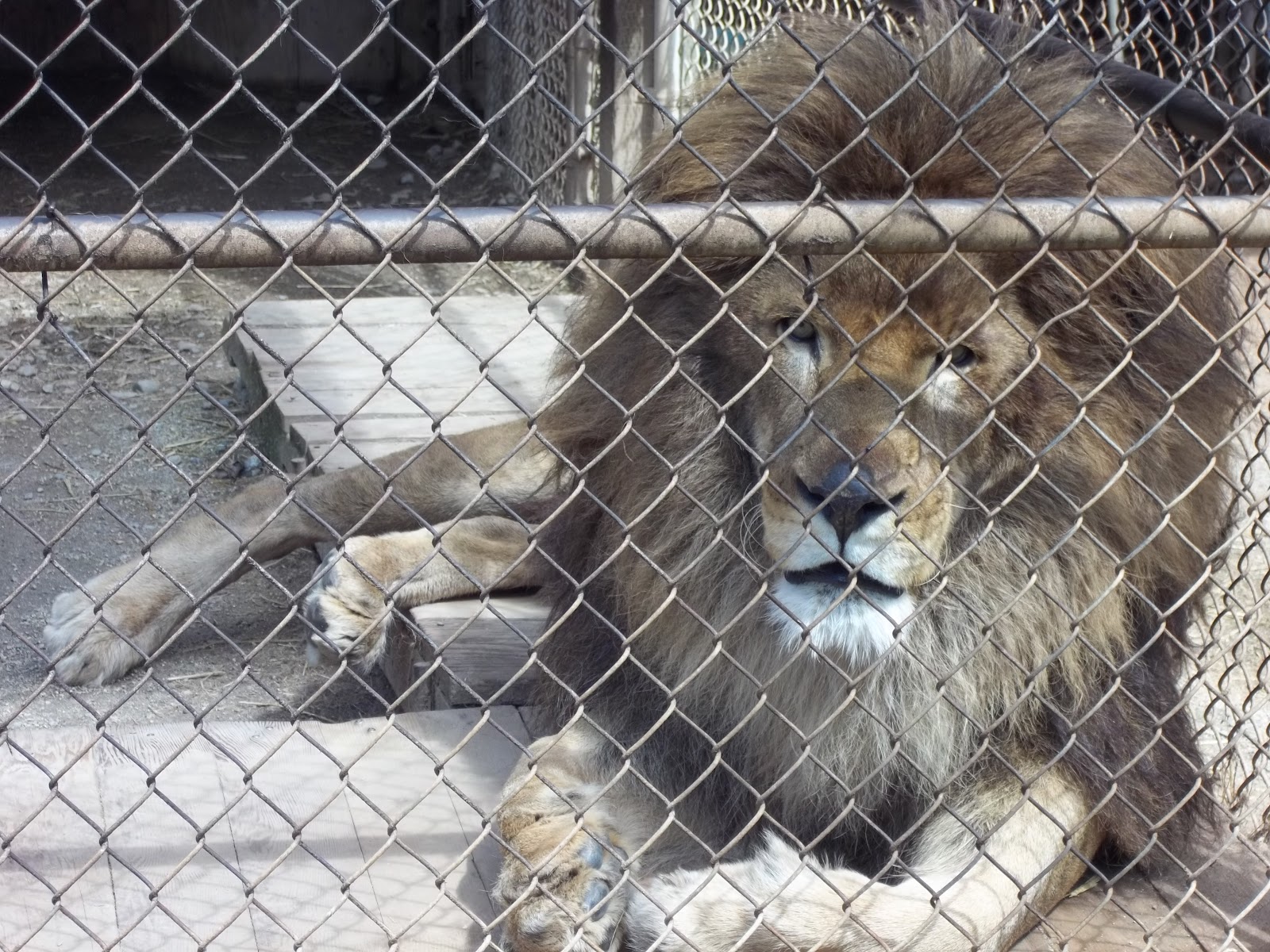
On day three of our trip, we went to the Great Cats World Park near Cave Junction, Oregon. It was a zoo devoted entirely to wild cats, and our tour guide was their main trainer. He is apparently something like the Steve Erwin of cats.
I love white tigers! Alexandra does, too.

The trainer did not go in the cage with the lion. I guess lions are finicky, and unless you have another experienced trainer in there as backup, one wrong move could cost you your life...
...however, tigers are much more stable, and he not only got in the cage with this one, but also rode it.

Later on we went to Big Tree Wayside, home of the Big Tree. While its name is not creative, it certainly was the biggest tree we saw.

We also went to the parking lot of a place called Trees of Mystery, because I couldn't resist posing by Paul Bunyan and Babe. Now when Alexandra is old enough to learn about American legends, I can show her this picture.

We had a great time!
Wednesday, April 18, 2012
Art Night and Pain: Part 2
So, after thinking about it a lot and reading the comments on my blog, here are my thoughts about art and pain. Many thanks to the people who gave me feedback, which really helped shape and clarify my own thoughts. I think it comes down to one particular theme for me, with a couple of sub-ideas feeding into it.
I think that art is a form of redemption for pain. Not, perhaps, in every sense of the word, but in the senses given to me based on the definition of "redeem" according to Dictionary.com: "to buy back" and "to recover." Dictionary.com, under "redemption," offers a definition from a Bible dictionary: "the purchase back of something that had been lost, the payment of a ransom." (Also, included in my idea is the Biblical sense that something is better and restored once it has been redeemed.)
I think that's what art does, at least when it comes to pain. Here's what I mean:
Art is typically aesthetically pleasing, or if not, is evocative of some emotion in a way that makes a statement. Through colors, shapes, words, pictures, or music, art constructs order and/or beauty and/or meaning. But even apart from the meaning, art is typically beautiful in and of itself, which in many cases is part of what makes it art. I remember being in a class once and listening to a poem written in a language I did not know. Listening to the poem stirred something in me because of the sounds and rhythms put together by the poet. I remember wondering that I could have an emotional reaction to something when I didn't even know what it was saying. But that's the case with many pieces of art. Somehow, because of the beauty and order they create or the emotion that they isolate and evoke, they become an object of value in and of themselves.
So, when an artist takes a painful emotion or experience and puts it into a piece of art, they are taking emotional wounds and redeeming them. The hurt, the pain, seems pointless; the effort of the artist pays the ransom and buys back the hurt, turning into something that has value in and of itself. In the case of extremely hurtful experiences, the beauty or value of the art may not be even close to what was paid in suffering. But something good has come out of something bad, redeeming it even if just a bit.
As I was coming to this conclusion, I questioned whether aesthetic objects alone are worth human suffering. After all, if you've been through something terrible, how could art ever begin to redeem your experience? I think there are two reasons beauty and order alone are worth it.
1) Soul scars (this term/idea was coined by my multi-talented friend Katie and I'm stealing it): People make art out of suffering because suffering shapes them. When people are betrayed, when natural disasters wipe out someone's home or town, when wars result in death, it seems that there is no good that can come out of such a thing.
2) Community: Art shows us we are not alone because it speaks to our souls. When you see a painting that moves you, or when you discuss the meaning of a novel with a good friend, or hear a piece of music that speaks to the despair you feel where a rational discussion never will, it gives you the sense that you are understood, comprehended. While you may not feel like the artist, writer, or composer is speaking to you directly, I think we've all seen, read, or heard something and had an inner reaction of "Yes! That's It!" It, referring to what we are feeling but cannot express. Knowing that someone else has created It helps us feel less alone. And so when we've had a painful experience, art relating to that experience becomes a way of communicating with others who've been there. It's too painful for words, but art lets us know we aren't alone. Art redeems that experience by giving us a deeper way to experience community.
Anyway, those are my thoughts. I'd love to hear any feedback/additions/perspectives any of you have. :)
Aside: I do not want to ignore the idea of art as an expression of the artist and a way of working through the pain. My goal in thinking about this was to examine why art that is about pain appeals not just to the artist, but to the audience as well.
I think that art is a form of redemption for pain. Not, perhaps, in every sense of the word, but in the senses given to me based on the definition of "redeem" according to Dictionary.com: "to buy back" and "to recover." Dictionary.com, under "redemption," offers a definition from a Bible dictionary: "the purchase back of something that had been lost, the payment of a ransom." (Also, included in my idea is the Biblical sense that something is better and restored once it has been redeemed.)
I think that's what art does, at least when it comes to pain. Here's what I mean:
Art is typically aesthetically pleasing, or if not, is evocative of some emotion in a way that makes a statement. Through colors, shapes, words, pictures, or music, art constructs order and/or beauty and/or meaning. But even apart from the meaning, art is typically beautiful in and of itself, which in many cases is part of what makes it art. I remember being in a class once and listening to a poem written in a language I did not know. Listening to the poem stirred something in me because of the sounds and rhythms put together by the poet. I remember wondering that I could have an emotional reaction to something when I didn't even know what it was saying. But that's the case with many pieces of art. Somehow, because of the beauty and order they create or the emotion that they isolate and evoke, they become an object of value in and of themselves.
So, when an artist takes a painful emotion or experience and puts it into a piece of art, they are taking emotional wounds and redeeming them. The hurt, the pain, seems pointless; the effort of the artist pays the ransom and buys back the hurt, turning into something that has value in and of itself. In the case of extremely hurtful experiences, the beauty or value of the art may not be even close to what was paid in suffering. But something good has come out of something bad, redeeming it even if just a bit.
As I was coming to this conclusion, I questioned whether aesthetic objects alone are worth human suffering. After all, if you've been through something terrible, how could art ever begin to redeem your experience? I think there are two reasons beauty and order alone are worth it.
1) Soul scars (this term/idea was coined by my multi-talented friend Katie and I'm stealing it): People make art out of suffering because suffering shapes them. When people are betrayed, when natural disasters wipe out someone's home or town, when wars result in death, it seems that there is no good that can come out of such a thing.
Yet, without suffering, we don't become the people we are. There have been many times in my life where I have heard people, both religious and nonreligious, talk about a difficult time in their life. Sometimes they say they wish it had never happened, but they often say that they wouldn't be the people they are without the experience. Without the suffering, they wouldn't be as patient or compassionate or wise or loving or even just experienced. Most Christians I know agree that the worst times in their lives are the times when they are closest to God and feel His love the most, and that pain is what gets our spiritual attention.
And when people don't have any struggles, they tend to become shallow. I know that in my own life, difficult times give me a broader, better perspective. And so I think art reminds us of those difficult times that made us who we are. It reminds us that being cut off in traffic is not the end of the world, that there are worse things than those we've been worry about, that it's better to be grateful for what you have than to pine for what you don't have. Physical wounds leave scars; emotional and spiritual wounds also need scars so we can remember how we became who we are. Art redeems the experience by creating a soul scar for us.
2) Community: Art shows us we are not alone because it speaks to our souls. When you see a painting that moves you, or when you discuss the meaning of a novel with a good friend, or hear a piece of music that speaks to the despair you feel where a rational discussion never will, it gives you the sense that you are understood, comprehended. While you may not feel like the artist, writer, or composer is speaking to you directly, I think we've all seen, read, or heard something and had an inner reaction of "Yes! That's It!" It, referring to what we are feeling but cannot express. Knowing that someone else has created It helps us feel less alone. And so when we've had a painful experience, art relating to that experience becomes a way of communicating with others who've been there. It's too painful for words, but art lets us know we aren't alone. Art redeems that experience by giving us a deeper way to experience community.
Anyway, those are my thoughts. I'd love to hear any feedback/additions/perspectives any of you have. :)
Aside: I do not want to ignore the idea of art as an expression of the artist and a way of working through the pain. My goal in thinking about this was to examine why art that is about pain appeals not just to the artist, but to the audience as well.
Subscribe to:
Posts (Atom)